


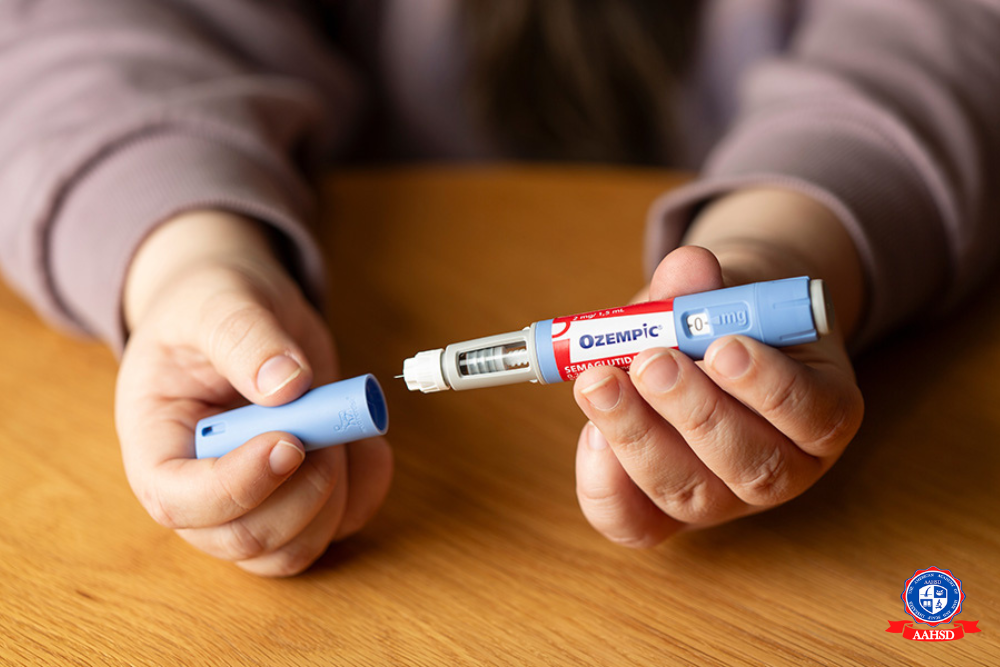
Ozempic, GLP-1s, and the Hidden Cost of Weight Loss: What Your Clients Need to Know
Over 15 million prescriptions for GLP-1 agonists were written in 2023 — but nowhere in the fine print does it say “may cause your client’s hair to fall out.”
You’ve likely heard the buzz: medications like Ozempic, Wegovy, and other GLP-1 receptor agonists are being marketed as miracle solutions for rapid weight loss. But behind the hype is a wave of women watching their hair thin, their vitality fade, and their trust in conventional care unravel — and many beauty professionals are left unsure of how to respond.
At the American Academy of Hair & Scalp Diseases (AAHSD), we train our students in Functional Trichology™ to see what others miss — and this is one of those moments.
The Issue Isn’t Just the Medication — It’s the Interruption of Physiology
GLP-1s slow gastric emptying, which means food lingers in the stomach longer. That may curb appetite, but it also disrupts nutrient absorption, throwing the hair growth cycle off balance.
A 2022 study in Diabetes, Obesity and Metabolism found GLP-1s can slow gastric emptying by up to 50%, limiting the uptake of vital hair-building nutrients like B12, zinc, and amino acids.
If your client is on these meds and suddenly complains of:
- Shedding 2–4 weeks after starting
- Thinning edges or a ponytail that feels noticeably thinner
- Digestive upset or nutrient resistance
- Fatigue or a lack of response to supplements
…the medication may be masking a deeper issue.
This Is Why Functional Trichology Was Created
Clients are arriving with devastating stories: fragile strands, thinning temples, and ponytails that once felt full now barely secure a tie. They’re told by doctors that Ozempic is a safe choice to support their weight. What they’re not told? That it could compromise their hair and health.
We’ve mapped the recurring patterns:
- Hormonal dysfunction before the medication
- Gut stagnation and poor digestion
- Liver congestion that blocks detox pathways
Their bodies couldn’t digest protein or absorb the nutrients needed to build healthy strands — and no one tested for that.
Using our Triangle to Recovery™ framework, Functional Trichology professionals evaluate what’s happening systemically, not just topically. When physiology is mapped and supported, clients often report:
- Improved digestion
- Restored energy
- Fuller ponytails
- Renewed confidence
What Professionals Must Understand
This is why AAHSD’s curriculum focuses on physiology mapping and recovery strategy — because:
- Hair doesn’t fall out without a reason
- The body gives signals — you must be trained to interpret them
- You cannot out-supplement poor absorption or detox
And medications? They’re often silencing a system that’s already screaming.
Why This Matters for You as a Beauty Professional
Most clients assume their stylist will notice hair changes before they do.
That makes you their first line of defense.
But here’s the gap:
- Conventional dermatology treats the scalp
- Conventional medicine treats the weight
- No one is trained to connect the two — except a Functional Trichologist
When you can recognize hair loss as a symptom of systemic dysfunction, you position yourself as more than a service provider.
You become the authority who can protect their hair and their health.
Conventional vs. Functional Insight
| Conventional Response | Functional Trichology Approach |
| See weight gain as the problem | Investigate the body burden underneath |
| Address symptoms with medications | Identify what the body is missing |
| Hope the hair returns after meds stop | Strategize for sustainable restoration |
We’re not here to scare your clients — we’re here to give you the language, tools, and clinical frameworks to show up as a true expert.
What to Say Behind the Chair
“Let’s explore what your body might be missing — not just what the meds are doing.”
“Hair loss isn’t random. It’s revealing.”
“This isn’t just about your scalp. Your hair’s telling us your body’s overwhelmed — and there’s a way to decode it.”
This Is Bigger Than Hair
When the stomach doesn’t empty, the liver gets overwhelmed. When protein isn’t digested, keratin and collagen can’t be built. When the gut is stagnant, hormones spiral.
This isn’t just hair loss — it’s a systemic malfunction.
If you’re a beauty professional witnessing this in your chair, you need to be able to:
- Connect the dots between meds and physiology
- Confidently refer clients to deeper care
- Position yourself as a trusted expert who gets results
That’s what Functional Trichology™ offers.
Be the Frontline — Not the Afterthought
Here’s the truth: by the time a client ends up in a medical office, their story has already been edited down to symptoms. But in your chair? You hear it all. You see the shift. You catch the hair in the comb, the break in her voice, the fear she hides behind styles and wigs.
You are not just a beauty professional. You are a first responder in the hair loss epidemic.
And right now, Ozempic and GLP-1s are sweeping through your client base like wildfire — with no education, no informed consent, and no real solutions for what happens next.
Functional Trichology arms you with the science, structure, and system-based thinking to intervene early, educate boldly, and position yourself as a credible expert in a field that is drowning in confusion.
Let the doctors write prescriptions — you translate what the body is trying to say.
Because Hair Loss is Health Loss™, and you were called to catch it before it’s too late.
Train With the Innovator: Ky Smith
As the founder of AAHSD and creator of Functional Trichology™, I developed this methodology because traditional trichology wasn’t asking the right questions. We go beyond the scalp — into the body systems, patterns, and burdens that lead to hair loss in the first place.
Our graduates learn to map dysfunction, decode systemic imbalances, and create custom strategies that help clients restore what was lost.
The future of hair care isn’t surface. It’s science-backed. It’s system-first. And it starts with you.
Ready to Learn the AAHSD Way?
If you’re ready to:
- Elevate your career with a credible, clinical approach
- Become the go-to expert for hair loss recovery
- Stop guessing and start mapping…
Apply to our next cohort of the iD Hair Loss BTC™ training or Functional Trichology™ Certification. Whether you’re a licensed stylist, barber, or braider, — if you’re serious about solving real problems, it’s time to upgrade how you serve.
FAQ: What Every Professional Should Know About GLP-1 Meds and Hair Loss
Is it really the medication causing the hair loss?
Often, yes — but indirectly. GLP-1s interrupt gastric emptying and digestion, which can starve the body of nutrients essential for hair growth. The medication doesn’t directly attack the follicle, but it weakens the system that supports it.
My client had hormonal issues before Ozempic — could that be part of it?
Absolutely. Most clients had underlying burdens (thyroid dysfunction, blood sugar imbalance, estrogen dominance) long before starting the medication. GLP-1s often compound the problem, not solve it.
If my client stops the meds, will the hair grow back?
Not always. Once systemic dysfunction sets in, stopping the medication alone doesn’t restore balance. Functional recovery must address digestion, detox, and nutrient repletion.
A dermatologist on the other hand is the licensed medical professional who has a specialty in hair, skin and nails. This professional can diagnose a condition and prescribe medication. In certain cases Trichologists and Dermatologist partner to increase the recovery rate for people with hair loss and scalp conditions. Dermatologists cannot legally use herbs or a holistic approach to reactivate the hair growth cycle, therefore all protocols will be prescription base.
Trichologists and Dermatologists are two separate professions that have a common goal in mind using two different approaches.
Can topical products like bonders or serums help?
No topical can override internal dysfunction. If the body isn’t building strong keratin from the inside, no serum will save the strand.
How do I explain this to my clients without fear-mongering?
Use confident, informed language. You’re not blaming — you’re educating. “Let’s explore what your body might be missing so we can restore from the root.”